You bring the opportunity. I turn it into software.
I work with experienced founders, business owners and investors to turn opportunities into production software - from rough concept through product definition, architecture, MVP, cloud infrastructure and live operation. Without you having to build an engineering organisation first.
Deliberately limited to a small number of ongoing partnerships.
Who this is for
People who keep spotting opportunities, have the means to pursue them, and have no interest in becoming a software founder or managing developers.
Exited & serial founders
Exploring the next business - or the next three - and want a trusted builder on call rather than a hiring plan.
Established business owners
You know your industry inside out and can see the software it's missing. You need someone who can build it properly.
Holding companies & family offices
Launching technology products, incubating ventures or building internal tools across a portfolio of businesses.
Investors & venture studios
Incubating ideas or backing founders who need a technical counterpart. See how I work with investors →
You bring
- The opportunity - a problem you've seen, a market you understand
- Domain expertise - years of knowing how your industry really works
- Distribution & network - customers, partners and people who'll take your call
- Capital - the means to pursue it properly
I bring
- Product refinement - turning the idea into something people will pay for
- Architecture - technical decisions that won't need undoing later
- Engineering - full-stack and backend development, integrations, data and automation
- Cloud & delivery - secure infrastructure, deployment and monitoring
- Ownership - someone who treats the outcome as theirs, not a ticket queue
From idea to operation
One person accountable for the whole journey - so nothing gets lost between the strategy, the build and the running system.
Idea
We pressure-test the opportunity together: who pays, why now, what already exists, and what would have to be true for it to work.
Validation
Find the cheapest credible way to prove demand - before anyone writes serious code.
Prototype
Something real enough to put in front of customers, partners or investors - and learn from their reaction.
MVP
The smallest genuinely useful product, built on foundations that won't need throwing away when it works.
Production
Secure, monitored cloud infrastructure that's ready for real customers, real data and real money.
Operation
Keep it running, improve it from customer feedback, and - if it takes off - help hire and hand over to an in-house team.
What a partnership covers
Closer to a fractional CTO and venture builder than a software contractor. The scope moves with the opportunity - one month that's product thinking, the next it's shipping features or hardening infrastructure.
- Refining business ideas into viable software products
- Identifying the smallest useful MVP
- Product and technical architecture
- Full-stack and backend development
- Cloud infrastructure and deployment
- Integrations, databases and automation
- AI features where they earn their place
- Production readiness, security and observability
- Iterating on real customer feedback
- Building your engineering team if the product succeeds
Not a prototype. Production software.
AI tools have made it easy to produce a convincing demo. Getting from a demo to something customers can rely on - with security, payments, backups, monitoring and a codebase a future team can inherit - is where most new ventures stall.
That gap is where I've spent my career: over a decade of architecture, cloud infrastructure, DevOps, data and integration work for enterprise teams, now applied to new ventures from day one.
- Yours, outright. Your repositories, your cloud accounts, your data - documented so anyone can pick it up.
- Built to be handed over. If the venture outgrows me, your first hires inherit something they can work with.
- Plain English. You'll always know what's being built, why, and what it costs to run.
Microsoft-certified across delivery, development, security and data

How partnerships are structured
You're paying for technical ownership and execution, not a number of days. Three shapes cover almost every situation.
Ongoing retainer
A fixed share of my capacity each month - typically one to two days a week - to investigate, prototype and build your opportunities as they come up.
Project + retainer
Substantial builds are scoped and priced as projects, with an advisory and development retainer alongside so momentum isn't lost between phases.
Cash + upside
For particularly compelling opportunities, a cash retainer or project fee combined with equity or profit participation - so we're aligned on the outcome.
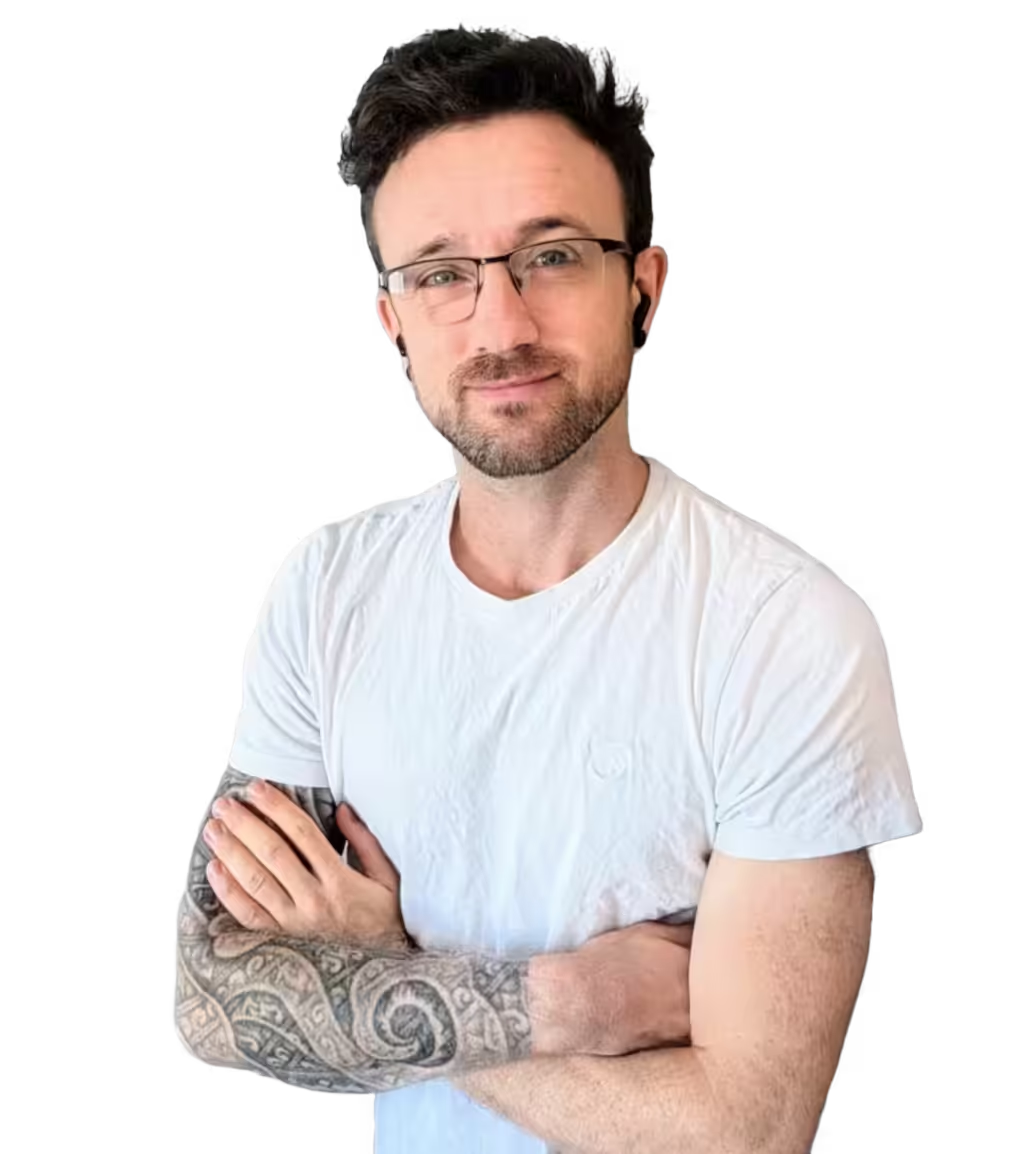
Give me the business problem or the opportunity - not a software specification. I'll help work out what should be built, and then build it.
- Carl Mills, Sentido
How we start
Low commitment at the beginning. Clarity before any big decision.
1) A conversation
Tell me about the opportunity and where you are with it. No pitch deck needed.
2) Opportunity review
A short, fixed-scope look at the idea, the market and the technical options - ending in a written recommendation on what to build first, roughly what it costs, and whether it's worth building at all.
3) Agree the shape
Retainer, project or partnership - whichever fits the opportunity and how involved you want to be.
4) Build & run
Short cycles, regular demos and plain-English updates - from first prototype to a system that runs without you thinking about it.
Deliberately small
I work with a small portfolio of two to four entrepreneurial relationships at a time. That's the point: you get senior attention, not an account manager. If there isn't capacity, I'll tell you when there will be.
Built for repeat opportunities
The best partnerships aren't one project. They're the call that starts with "I've spotted something in one of my businesses - can you look into whether we could build around it?"
Common questions
Investor or venture studio?
I also work as a technical operator investors can introduce to their founders.
For investorsLooking for something smaller?
Fixed-scope consulting and affordable starter packages are available too.
Compare optionsSpotted an opportunity?
Tell me about it. If it's a fit, we'll talk about how to build it. If it isn't, I'll tell you that too.